
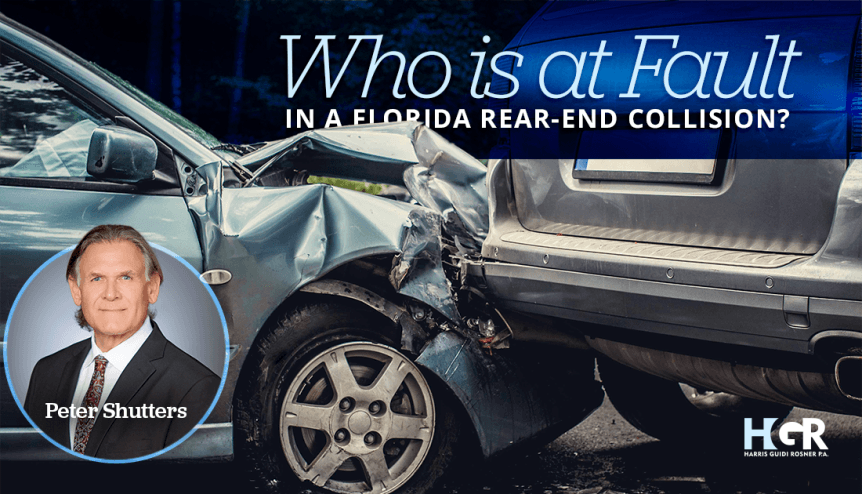
Rear-end collisions are among the most common crashes on Florida roads, and one of the most frequently misunderstood from a legal standpoint. Many people assume that the driver in the back is always at fault. Florida law is more nuanced, and understanding how fault is actually determined in a rear-end crash can have a significant effect on your ability to recover compensation.
Florida’s Rebuttable Presumption of Negligence Against the Rear Driver
When a rear-end collision occurs in Florida, the law begins with a presumption that the driver who struck the vehicle in front was negligent. This is not a statutory rule but a well-established principle of Florida common law, built through decades of appellate decisions. The presumption arises from the basic duty every driver has to maintain a safe following distance and to be able to stop safely when traffic ahead slows or stops.
The word “rebuttable” is critical. This presumption is not conclusive. The rear driver, or their insurer, may present evidence to overcome it. Florida courts have consistently recognized that the presumption can be rebutted when the facts support a different conclusion.
When the Presumption Can Be Overcome
Florida appellate courts have identified several circumstances under which the presumption of rear-driver negligence may be rebutted or fault may shift partially or entirely to the front driver:
- Sudden and unjustified stop: If the front driver stopped abruptly without a legitimate reason, such as normal traffic flow, a traffic signal, or a road hazard, and the stop was so sudden that a reasonably cautious driver following at a safe distance could not have avoided the collision, the front driver may bear some responsibility. This is sometimes called the “sudden stop” defense.
- Unsafe lane change: If the front driver cut into the lane immediately ahead of the rear driver, leaving insufficient space to stop safely, the front driver may be partially or primarily at fault for the resulting crash.
- Malfunctioning brake lights: If the front vehicle’s brake lights were non-functional and the rear driver had no warning that the vehicle was slowing or stopping, this may support a finding of fault against the front driver.
- Reversing without warning: A vehicle that backs into a forward-moving vehicle may shift fault entirely to the driver who was reversing.
- Disabled vehicle without hazard lights: A vehicle stopped in a travel lane without activating hazard lights creates a foreseeable hazard, and the driver of that vehicle may bear some responsibility for a resulting rear-end collision.
Evidence matters enormously in these situations. Dashcam footage, black box data from the vehicles involved, traffic camera recordings, witness statements, and the official crash report all play a role in establishing what actually happened. Gathering and preserving this evidence quickly is one of the most important early steps in any rear-end collision claim.
How Florida’s Comparative Fault Law Applies
Even when the rear driver is primarily at fault, the question of shared fault can significantly affect the final recovery. Under Florida Statute Section 768.81, Florida follows a modified comparative negligence standard. In a negligence action, contributory fault chargeable to the claimant reduces the amount awarded proportionally. Critically, any party found to be greater than 50 percent at fault for their own harm may not recover any damages at all.
In practice, this means that an insurance company defending a rear-end collision claim has a strong incentive to argue that the injured front-driver was partially at fault, perhaps for brake-checking, stopping suddenly, or having malfunctioning lights. Even pushing a claimant’s assigned fault from 20 percent to 51 percent eliminates the entire claim. This is why how fault is investigated, documented, and contested matters so much in rear-end cases.
Common Injuries in Florida Rear-End Collisions
Rear-end collisions produce characteristic injury patterns. The sudden forward acceleration of the struck vehicle and the abrupt deceleration that follows places severe stress on the cervical spine and surrounding soft tissue. Common injuries include:
- Whiplash and cervical soft tissue sprains and strains
- Herniated or bulging discs, most commonly in the cervical and lumbar spine
- Traumatic brain injuries, including concussion, even at relatively low speeds
- Shoulder and wrist injuries from bracing against the impact
- Lumbar spine injuries
Many of these injuries are not immediately apparent in the hours following the crash. Symptoms may develop over the following days. Seeking prompt medical evaluation is essential both for your health and for establishing a documented connection between the accident and your injuries. Under Florida Statute Section 627.736, you must seek initial medical treatment within 14 days of the accident to remain eligible for Personal Injury Protection benefits under your own auto insurance policy.
What to Do After a Rear-End Collision in Jacksonville
- Call law enforcement and obtain an official crash report. The report documents the basic facts of the accident and identifies the involved parties.
- Photograph the scene, all vehicles, road conditions, and any visible injuries before vehicles are moved if it is safe to do so.
- Collect names and contact information from witnesses.
- Seek medical evaluation within 14 days to preserve your PIP benefits and create a contemporaneous record of your injuries.
- Do not give a recorded statement to the other driver’s insurance company without consulting an attorney. Adjusters are trained to ask questions in ways that can minimize your claim or establish partial fault.
Whether you were rear-ended or you are the driver being blamed for a rear-end crash, the legal and factual analysis is rarely as simple as it first appears. The personal injury team at Harris Guidi Rosner, P.A. handles rear-end collision cases throughout Jacksonville and Northeast Florida. We handle these cases on a contingency fee basis, meaning you owe nothing unless we recover compensation for you.